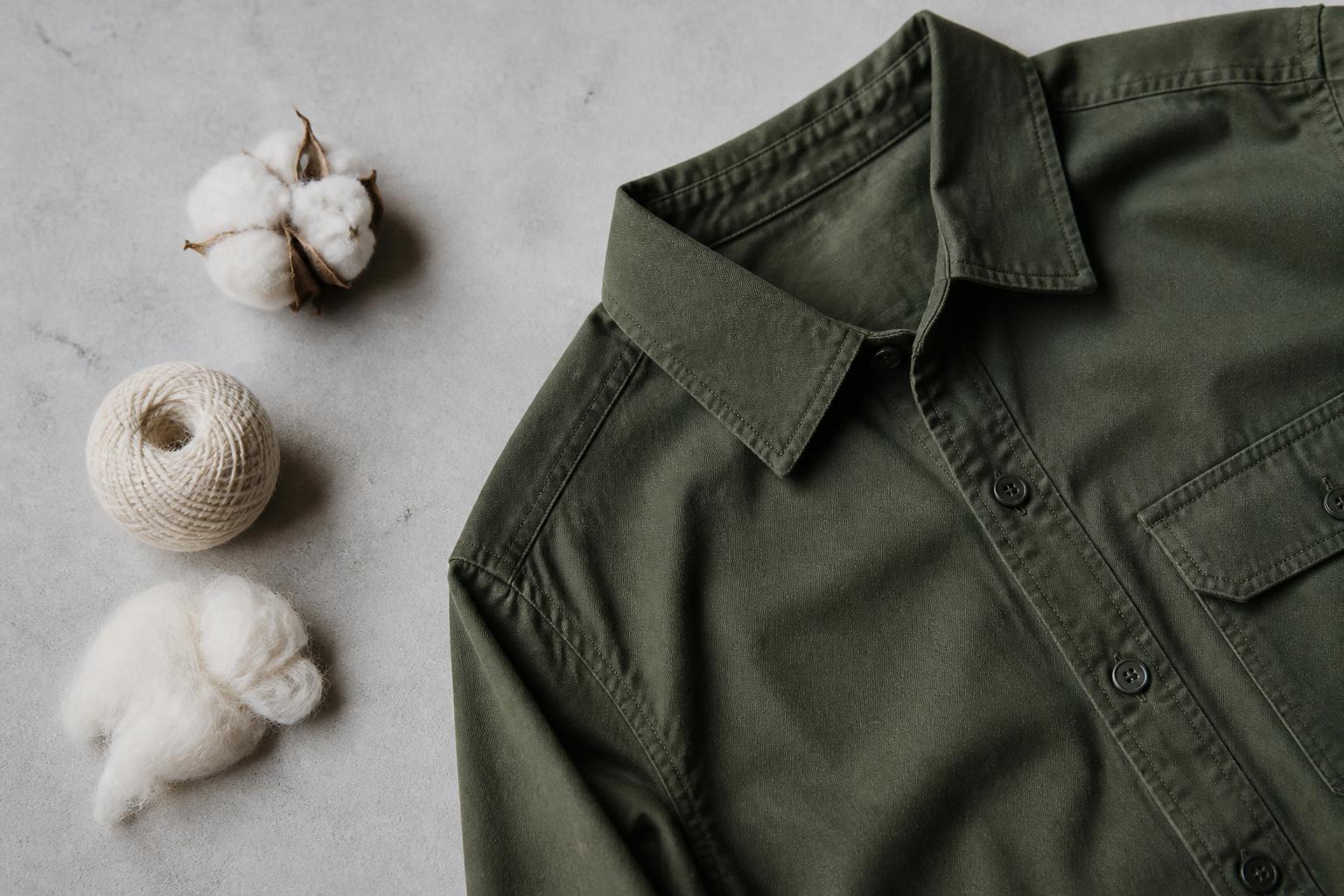
Buying better menswear starts with a simple test. Ignore the mood words first and look for claims that can be checked. If a garment is described as eco, conscious, responsible or sustainable, that tells us almost nothing on its own. A credible claim names the material, the standard, the stage of production, or the exact improvement being made.
That matters because lower impact clothing is rarely “good” in every sense. One shirt may use organic cotton but reveal nothing about dyeing or factories. Another may use recycled fibres but be hard to repair and full of mixed trims. If we want to judge eco friendly men’s clothing properly, we need to compare what is actually evidenced, what is left unsaid, and whether the item looks likely to last.
What counts as a credible claim on men’s clothing
The quickest way to separate evidence from marketing is to ask, “Claim about what, exactly?”
A strong claim is narrow and verifiable. For example:
- “Made with 100% GOTS certified organic cotton”
- “Contains 60% pre-consumer recycled wool, certified to the Recycled Claim Standard”
- “Dyed in a bluesign approved facility”
- “Cut and sewn in Portugal at a factory named on our supplier list”
Each of those statements gives us something concrete to assess. We can check whether the standard applies to the fibre, the chemical inputs, the chain of custody, or the manufacturing site. We can also see where the claim begins and ends.
A weak claim stays broad. Phrases like “planet conscious”, “made responsibly”, “crafted with care”, or “our green collection” often bundle several ideas together without proving any of them. They may still sit on top of better practice, but the words themselves are not evidence.
Useful details usually include at least one of the following:
- Fibre composition in percentages
- Whether a fibre is virgin, organic, recycled, regenerative, or conventional
- A named certification or audit scheme
- Country of fibre origin, spinning, weaving or knitting, dyeing, and final assembly
- Named mill or factory
- Information on durability, repairability, or aftercare
- A clear explanation of what the claim does not cover
That last point is often overlooked. The most trustworthy brands tend to define their limits. If a jacket uses certified wool outer fabric but the lining and interlinings are not traced, saying so is more credible than implying the whole garment meets the same standard.
In the UK, this also matters from a consumer protection point of view. Environmental claims must not mislead. The Competition and Markets Authority’s Green Claims Code is not a clothing standard, but it does set the expectation that claims should be truthful, clear, and substantiated. So when we see “sustainable shirt” with no explanation, the problem is not only that it is unhelpful. It may also be hard to justify.
If you want a broader framework for spotting weak language, our guide to greenwashing risk in fashion claims sets out the common warning signs.
Which fibres usually appear in lower-impact menswear
No fibre is impact free. The better question is what a fibre may improve, and what problems it does not solve.
Organic cotton is one of the most common materials in lower impact menswear. Its main strength is agricultural. It avoids synthetic fertilisers and pesticides under the standard used, and it is often easier to trace through certification systems than conventional cotton. What it does not tell us by itself is how the fabric was dyed, how much water was used locally, how durable the finished cloth is, or whether the garment factory pays well.
Recycled fibres can reduce demand for virgin raw material. In menswear, that often means recycled cotton, recycled polyester, recycled nylon, or recycled wool. Recycled wool can be especially useful in knitwear and coating, where fibre blending and texture already suit the material. Recycled polyester may divert waste feedstock and reduce reliance on virgin fossil inputs, but it is still a synthetic fibre and still raises questions about microfibre shedding in wear and laundry. Recycled cotton can be valuable, though it is often blended with virgin cotton or synthetics because recycled cotton fibres are shorter and may reduce strength if used alone.
Wool has a strong place in lower impact menswear because it is durable, repairable, insulating, and naturally odour resistant. A good wool jumper or coat can stay in use for years, which matters as much as raw material choice. But wool is not simple. Impact depends on farming systems, land management, chemical use in processing, animal welfare, and whether the fibre is traceable. Claims about “natural” wool are not enough. We need to know whether the brand can say where it came from and what standards apply.
Linen is often a strong option for shirts, tailoring blends, and summer clothing. Flax can perform well with lower agricultural inputs than some other fibres, and linen fabrics can be long lasting if woven well. But again, the fibre alone does not settle the whole picture. Retting, spinning, bleaching, dyeing, and finishing all affect impact. A flimsy linen shirt with fused construction and poor stitching is not made better simply because flax was involved.
Man-made cellulosics, such as lyocell, modal and viscose, sit in a more technical middle ground. They are made from wood pulp or other cellulose feedstocks, so they are not synthetic in the same way as polyester. Their main concerns are forest sourcing and chemical processing. Better versions usually involve responsibly sourced wood, stronger controls on hazardous solvents and effluent, and more transparent supply chains. Lyocell is often presented as the cleaner option because of its solvent system, but the real question is still which producer, which feedstock, and what evidence is available.
Fibre blends need extra care. A cotton shirt with 2% elastane may fit well and recover shape better, but it is harder to recycle than a mono-material shirt. A wool coat with a polyester lining may perform better in wear, but mixed materials complicate end of life sorting. There is no rule that says blended is bad. We simply need to count the trade off honestly.
For readers comparing fibres beyond menswear, our piece on whether silk is a responsible fabric choice shows how similar trade offs appear in another category.
What certifications can and cannot prove?
Certifications are useful when we understand their scope. They are much less useful when treated as a universal badge of goodness.
GOTS, the Global Organic Textile Standard, is one of the most relevant schemes for organic natural fibres in clothing. It covers more than the farming stage. It also sets criteria for processing, chemical inputs, and social requirements at certified facilities. That makes it stronger than a simple claim that cotton is organic. But GOTS does not guarantee that every component in a garment is organic, and not every factory in a brand’s chain will necessarily be certified unless the product is sold as such through the full chain of custody.
The Organic Content Standard, OCS, is narrower. It verifies the presence and amount of organically grown material in a final product and tracks it through the supply chain. It does not set the same broad processing and social requirements as GOTS. So “OCS certified organic cotton” can be a valid material claim, but it proves less overall than GOTS.
For recycled inputs, the Global Recycled Standard, GRS, and the Recycled Claim Standard, RCS, are common. RCS focuses on verifying recycled content and chain of custody. GRS goes further by adding processing criteria and social and environmental requirements at certified sites. Neither standard tells us that a garment is low impact in every respect, but both are more meaningful than an unqualified claim that something is “made from recycled materials”.
OEKO-TEX STANDARD 100 is often misunderstood. It tests finished textiles and components for certain harmful substances. That can be valuable, especially for skin contact items. But it is not a broad environmental certification for farming, climate impact, or labour conditions.
bluesign is primarily about chemical management and cleaner production inputs in textile processing. It can be a strong signal on restricted substances and manufacturing controls, particularly at mill level. It does not by itself prove that the fibre was organic, recycled, or ethically sourced at farm level.
On social conditions, SA8000 and Fair Trade related schemes may be relevant, though they appear less consistently across mainstream menswear than fibre standards do. Sedex and SMETA are also common in supplier disclosure, but they are audit tools and reporting frameworks rather than product certifications. A brand saying “our factory is SMETA audited” is giving one piece of information, not proving that all labour issues are solved.
For forest-based fibres, FSC or PEFC can be relevant to the wood source, though that still does not cover all processing concerns for viscose, modal or lyocell. Some brands also refer to CanopyStyle or individual producer systems. Those can be useful, but they are not interchangeable with product certification.
In the UK, post-Brexit labelling and product rules may differ from the EU in some areas, but the broad standards above are international and still commonly used in both markets. Where the UK and EU differ more noticeably is in the legal framework around consumer claims and market surveillance. For a shopper, the practical point is this, a recognised standard helps, but it never replaces reading the exact wording of the claim.
How to read sourcing and manufacturing information
The best sourcing pages do not just tell us a garment was “made in Europe” or “crafted ethically”. They map the chain in a way that lets us follow it.
For clothing, useful disclosure usually covers at least some of these stages:
- Fibre origin, such as Australian wool or Indian organic cotton
- Spinning
- Weaving or knitting
- Dyeing and finishing
- Cut, make and trim, often shortened in industry to CMT
- Final assembly and sometimes packing
A strong product page might say: cotton grown in Turkey, spun in Turkey, woven in Portugal, dyed and finished at a named Portuguese mill, cut and sewn at a named factory in northern Portugal. That level of detail is far more useful than a single “Made in Portugal” line, because it tells us where most of the value-adding and most chemically intensive stages may have happened.
Named suppliers matter. If a brand lists mills and factories, we can start to see whether it has stable sourcing relationships or is simply attaching a country label at the end. Some businesses now publish supplier lists, factory addresses, or interactive maps. Others give batch or product-level traceability via QR codes. Those tools vary in quality, but the good ones identify real facilities and real stages, not just a story about craftsmanship.
We also look for clarity on subcontracting. In clothing production, embroidery, washing, printing, pleating, and specialist finishing are often done by separate facilities. If a brand only names the final sewing factory, that is useful but incomplete.
Processing information is another sign of seriousness. Helpful examples include:
- Whether denim is garment dyed, piece dyed, or left undyed
- Whether leather trims are avoided or vegetable tanned
- Whether waterproofing uses fluorinated chemistries
- Whether buttons are corozo, recycled polyester, horn, or metal
- Whether fusible interlinings are used heavily in tailoring
These details matter because trims and finishes can change the impact and repairability of a garment significantly. A simple overshirt in one fibre with standard buttons is easier to understand, and often easier to recycle, than a jacket with mixed shell, mixed lining, membrane, bonded interlinings, coated zips, and glued patches.
The same principle applies outside the garment itself. If a brand makes strong environmental claims, its packaging disclosures should be just as specific. We have set out what that looks like in our guide to clothing packaging with less waste and fewer weak claims.
How to compare two garments without guessing
When two items make similar claims, we compare them in layers rather than looking for one magic answer.
Start with fibre composition. A shirt that is 100% certified organic cotton is easier to assess than one made from a cotton-polyester-elastane blend with no percentages or certification. A knit in certified wool or a high recycled wool blend may be stronger on longevity than a thin acrylic knit labelled “conscious” with no further detail.
Then look at durability signals. These include fabric weight where given, dense stitching, spare buttons, reinforced stress points, repair services, replaceable components, and care instructions that suggest normal wear rather than fragility. Brands rarely publish abrasion scores or seam strength for everyday clothing, so we often have to read durability through construction clues.
Next, assess trim complexity. Fewer mixed materials generally means easier repair and clearer end of life handling. A coat with removable buttons, sewn-in rather than bonded construction, and a simple lining arrangement may be preferable to one with laminated layers and numerous synthetic extras, even if both claim recycled content.
Dyeing and finishing come after that. Natural colour, undyed fabric, or clearly managed dye processes can be positives, but only if the claim is specific. “Eco dye” means nothing unless the method or standard is named. Dark saturated colours, heavy washes, distressed finishes, and performance coatings can all add processing complexity. That does not make them automatic deal breakers, but it should affect how we weigh the claim.
Finally, judge the evidence quality itself. Ask:
- Are percentages given?
- Is the certification named correctly?
- Does the standard match the claim being made?
- Are mills or factories named?
- Is the claim product-specific, or just brand-wide mood language?
- Does the brand admit what it does not yet know or cover?
This last step often decides the comparison. A garment with a slightly less impressive material mix but far better disclosure may be the safer choice than one making bolder claims with no proof behind them.
In practice, we would rather buy from a brand that says, “This overshirt is made from 70% recycled wool and 30% polyamide, woven at X mill, made at Y factory, with GRS certification covering the recycled content, and we are still working on button traceability,” than from one that says, “Our most sustainable overshirt yet,” and stops there.
That is the real test for eco friendly mens clothing. Not whether the page sounds virtuous, but whether the brand has told us enough to judge the garment as it is. When we can see the fibre, the processing, the sourcing, the limits, and the likely lifespan, we are no longer buying on tone. We are buying on evidence.

Questions about this article or a correction to suggest? Get in touch. Read more about our editorial approach.