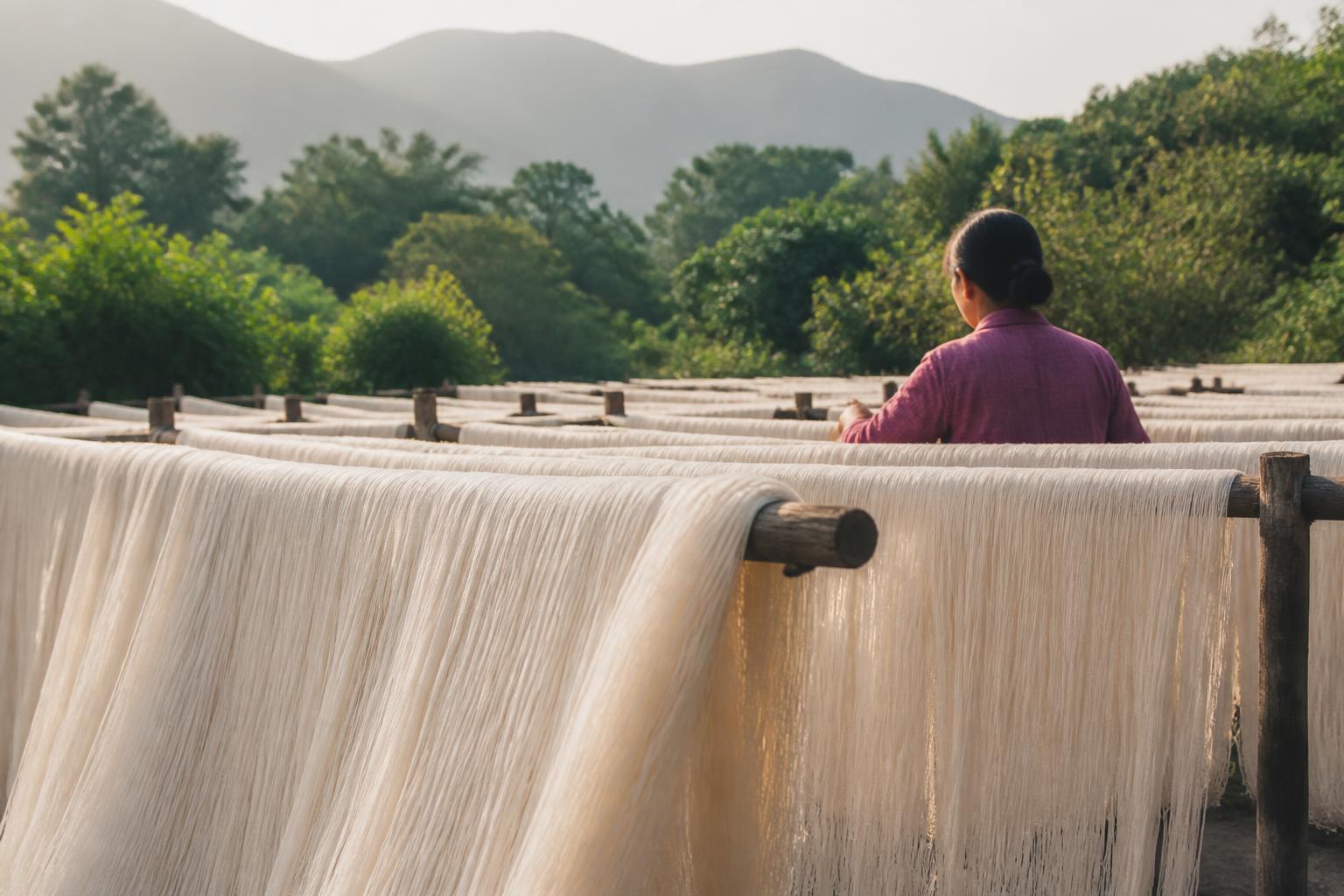
Silk can be a responsible fabric choice in some circumstances, but it is not responsible by default. If you are asking whether silk is sustainable, the honest answer is that it depends heavily on how the mulberry is grown, how the cocoons are produced, how the fibre is processed, dyed and finished, and how transparent the brand is about all of that. A silk blouse with poor traceability and heavy wet processing can carry a very different footprint from one made with stronger controls on farming, chemicals and wastewater.
Silk also raises a question that does not apply to plant fibres in the same way, animal welfare. Conventional silk production usually involves killing the silkworm pupa inside the cocoon so the filament can be reeled intact. Some shoppers accept that as part of a natural fibre system, others do not. That is why silk sits in a more contested place than many marketing claims suggest.
What makes silk appealing and why is it debated?
Silk is a protein fibre, most commonly made from the cocoons of the domesticated silkworm, Bombyx mori, which is typically raised on mulberry leaves. Fashion values silk because it does several things at once. It has a distinctive lustre, drapes beautifully, takes colour well, feels smooth against the skin, and can be woven or knitted into everything from lightweight georgette to structured dupion. In jewellery presentation and accessories, silk is also used for ribbons, pouches and linings because it signals luxury in a way few fibres do.
The debate starts because silk’s beauty tells us very little about its supply chain. It is a natural fibre, but natural does not automatically mean low impact. Silk production involves agriculture, insect rearing, fibre extraction, degumming, dyeing and finishing. Each stage can vary significantly by region, mill and standard of control.
The first contested issue is fibre origin. Mulberry cultivation can be relatively low input in some systems, but it can also involve irrigation, fertilisers and pesticides. Land use matters too. A small scale mixed farming system is not the same as a more intensive monoculture.
The second issue is processing. Raw silk is coated in sericin, a natural gum that must usually be removed to create the soft, lustrous silk most consumers recognise. Degumming, bleaching, dyeing and finishing all use water, heat and chemicals. The environmental profile of silk can shift sharply at this point, especially where wastewater treatment is weak or chemical management is opaque.
The third issue is animal welfare. Standard reeled silk depends on keeping the filament unbroken, which usually means the cocoon is heated or boiled before the moth emerges. There are alternatives sold under names such as peace silk, cruelty free silk or Ahimsa silk, but these terms are not always used consistently and they can involve trade-offs in fibre quality, yield and traceability.
So when people ask whether silk is sustainable, they are often bundling together several separate questions. Is it lower impact environmentally than the available alternatives? Is it processed with credible controls? Is it acceptable from an animal welfare point of view? A single yes or no rarely survives contact with the details.
How silk is made and where the main impacts arise
Silk production begins with sericulture, the rearing of silkworms. Eggs hatch into larvae, the larvae feed primarily on mulberry leaves, and after several growth stages they spin cocoons. Those cocoons are then sorted and processed.
If the aim is filament silk, the cocoon is stifled, usually with heat, to prevent the moth breaking the filament when emerging. The cocoon is then softened in hot water and the filament is reeled off. Several filaments are combined to make a usable yarn. If the cocoon has already been broken, or if shorter fibres are used, the result may be spun silk rather than reeled silk, with a different handle and appearance.
At the farming stage, the main impacts can include land use for mulberry cultivation, water use where irrigation is needed, and agricultural inputs. The picture differs by country and region. Rainfed mulberry grown in a mixed farming system does not look the same as irrigated production using synthetic fertilisers and crop protection products. Labour conditions matter here too, especially in fragmented supply chains where family farms and small reelers may sit outside robust auditing.
The next impact point is energy and water in cocoon processing and reeling. Heating water, drying cocoons and operating reeling equipment all require energy. The source of that energy matters. A mill using a grid with a high fossil fuel share will not have the same emissions profile as one using a cleaner energy mix or well evidenced renewable power.
Degumming is often the stage readers overlook. Sericin is removed by washing the silk in hot water with soaps, alkalis or other processing agents. Done well, this is a controlled industrial process. Done badly, it can mean high water use and poorly managed effluent. Dyeing and finishing can add further impacts through dyestuffs, auxiliaries, fixing agents and finishing treatments. If a silk fabric is marketed as easy care, stain resistant, wrinkle resistant or especially bright, we want to know what chemistry was used to get there.
Printing, embellishment and lamination can move the material even further from the simple image of a natural fibre. A silk garment with synthetic interlinings, mixed fibre lace, plastic sequins and solvent heavy finishes is not meaningfully assessed by looking at the base fibre alone.
Waste also arises along the way. Broken cocoons, short fibres, wastewater sludge, offcuts and unsold stock all matter. A responsible silk story should not stop at the cocoon. It should include whether by-products are used, whether wastewater is treated, and whether the finished item is durable enough to justify a resource intensive fibre.
For small brands, the practical issue is usually not that silk is impossible to source responsibly, but that the chain is often long and layered. A UK label may buy from an agent, who buys from a fabric wholesaler, who buys from a mill, which buys yarn from another source, which buys cocoons from many farms. Without good documentation, broad claims about responsible silk can quickly outrun the evidence.
How does silk compare with other fashion fibres?
Comparisons are useful, but only if we keep the scope narrow. There is no universal league table where silk sits neatly above or below polyester, cotton or wool in every respect.
Compared with polyester, silk is biodegradable in principle and derived from a biological source rather than fossil feedstock. It does not create the same microplastic shedding issue that synthetic fibres do. But polyester can be extremely durable, lightweight and efficient in some uses, and its impacts depend on whether we are comparing virgin or recycled inputs, how often the item is worn, and how it is laundered. A long lasting polyester lining used for years is a different proposition from a short life trend piece.
Compared with conventional cotton, silk may use less land in some contexts, but that is not a rule we can state without knowing the farming system and yield. Cotton’s biggest concerns often centre on water stress, pesticides and soil impacts in particular regions. Silk’s concerns often cluster around cocoon production, processing emissions, chemical use and animal welfare. Comparing them fibre to fibre without context can mislead.
Compared with wool, silk shares the fact that it is an animal derived fibre, but the welfare questions are different. Wool raises issues around land management, methane, mulesing in some countries, scouring and chemical treatments. Silk raises questions about insect life, cocoon stifling and wet processing. Neither fibre is simple, and both can be produced under stronger or weaker systems.
This is why broad statements such as “silk is always better than polyester” or “silk is worse than cotton” do not help much. The more useful comparison asks, better for what, under which production system, and over what lifespan? A well made silk scarf worn for years, repaired when needed and bought from a transparent maker may be a sound choice. A heavily processed silk item bought for one event and never worn again may not be.
For readers trying to sharpen that judgement, our guides on how to spot greenwashing before you buy fashion and the seven greenwashing traps fashion shoppers should spot are useful companions, because fibre claims often become overconfident precisely when the underlying comparison is incomplete.
What do silk certifications and standards actually cover?
This is where many silk claims become blurred. There is no single label that proves silk is fully responsible in every sense. Different standards cover different parts of the chain.
Organic claims usually relate to the agricultural stage. For silk, that may mean organic mulberry cultivation and restrictions on certain synthetic pesticides and fertilisers. In practice, certification may sit with the farm stage, the fibre stage or a finished textile chain, depending on the scheme. In the UK, products sold with organic textile claims should be backed by recognised certification and clear scope. If a brand says simply “organic silk” without explaining whether that refers to mulberry cultivation, yarn production or the whole textile chain, we would want more detail.
Chemical management standards are separate. OEKO-TEX Standard 100, for example, is a product testing label focused on restricted substances in the finished textile. It can be useful, especially for skin contact items, but it does not by itself prove low impact farming, low carbon production or strong animal welfare. Likewise, a bluesign related claim speaks more to chemical input management and process control in participating facilities than to the entire ethical profile of the silk.
Chain of custody is another distinct issue. Standards such as the Global Organic Textile Standard, where applicable, and other transaction certificate based systems are valuable because they connect certified input to the finished product through documented processing steps. Without chain of custody, a brand may be relying on a supplier statement that is difficult to verify beyond one tier.
Animal welfare language needs the most caution. Terms such as peace silk, vegan silk substitute, cruelty free silk and Ahimsa silk are used unevenly. Some refer to silk made after the moth emerges, which breaks the filament and changes the yarn structure. Some are house terms with no independent certification behind them. Some are sincere but poorly documented. If welfare is central to your decision, ask exactly what happened at cocoon stage, who verified it, and whether the claim is independently audited.
In the UK, environmental marketing is shaped by the Competition and Markets Authority’s Green Claims Code. That means broad statements such as “eco silk” or “sustainable silk” should be truthful, clear and supported by evidence. If a brand sells into the EU as well, it may also need to think about wider EU consumer law and emerging rules on substantiation, but UK readers should not assume an EU style claim framework applies identically here. The practical point is the same, though. A label should match the evidence, and the evidence should match the exact claim.
If you want a broader framework for judging this kind of proof, our piece on how fashion campaigns prove claims without greenwash sets out what good evidence looks like in plain language.
What should UK readers look for before trusting a silk claim?
Start with the most basic question, what kind of silk is it, and where was it processed? “Made in Italy” may tell you where the fabric was woven or the garment was sewn, but not where the cocoons were produced or where the yarn was reeled. We look for country level detail at more than one stage, ideally farm or cocoon origin, spinning or reeling, weaving or knitting, dyeing and finishing.
Next, ask what exactly the environmental claim refers to. If a brand says its silk is sustainable, do they mean certified organic mulberry, reduced chemical processing, closed loop water treatment, non toxic dye chemistry, renewable energy at the mill, or simply that silk is natural? These are not interchangeable. Vague language is often a sign that the evidence is thin.
Then check whether the proof matches the claim. Useful evidence includes current certificates, the name of the standard, the certifying body, and where relevant a transaction certificate or chain of custody reference. A finished fabric test for harmful substances is helpful, but it is not the same as proof of farming practices or full supply chain traceability.
For welfare claims, read the wording closely. If the item is described as peace silk or Ahimsa silk, we would expect the brand to explain the production method clearly. Was the moth allowed to emerge? Is the yarn spun from broken fibres rather than reeled as continuous filament? Who checked that process? If the explanation stops at a poetic phrase about harmony with nature, that is not enough.
Small businesses sourcing silk should also ask mills and agents practical questions in writing. What degumming chemicals are used? Is wastewater treated on site or through a municipal system? Are there restricted substance lists? Can the supplier provide recent audit documents or test reports? Are minimum order quantities pushing you towards deadstock or stock service fabrics where traceability is weaker? These are normal trade questions, not signs of distrust.
For shoppers, the warning signs are familiar. A swing tag that says “natural, therefore sustainable”. A luxury narrative with no sourcing detail. A welfare claim with no independent backing. A certification logo that covers only one narrow issue but is used to imply a complete ethical story. If that sounds familiar, our guide to how to spot greenwashing in fashion claims goes deeper into the patterns to watch.
So, is silk sustainable? Sometimes, partly, and only with enough detail to show why. Silk can sit within a responsible wardrobe or product range, but it does not get there on reputation alone. For UK readers and small brands alike, the best approach is to separate fibre romance from supply chain facts, then decide whether the evidence supports the claim being made.

Questions about this article or a correction to suggest? Get in touch. Read more about our editorial approach.