Jewellery often carries more meaning than its price or material weight. It may mark a relationship, a milestone or a memory. That can make a thoughtful sourcing conversation especially worthwhile, but it can also make reassuring language unusually persuasive.
Before you commit, separate the questions about the metal, the stones, the maker and the services that will keep the piece wearable. “Ethical jewellery” is a starting description to investigate, not a complete specification.
Begin with the piece and how it will be worn
Explain whether the item is for daily wear, occasional use or display. Tell the jeweller about practical constraints that matter: the need to resize, a fastening you can manage, or work that makes delicate designs inconvenient. This helps keep sourcing discussions connected to a useful purchase.
Set a realistic budget before becoming attached to a design. Include known alteration or servicing costs, and ask which later costs are uncertain. There is no obligation to increase your budget because a product is presented as responsible.
If you already have an appropriate piece, consider whether repair or adaptation would meet the need. For a gift, check the recipient's preferences discreetly rather than assuming the sourcing story will compensate for a style they do not enjoy.
Ask about the metal separately
Request the metal description and the precise sourcing claim. If the gold is described as Fairtrade, Fairmined or recycled, ask which scheme or definition applies and how the claim connects to the item. These descriptions are not interchangeable.
The Fairtrade Foundation and Fairmined provide their own programme information. Use the official source to understand a named scheme rather than relying entirely on a retailer's summary.
If a product contains more than one metal component, ask whether the claim applies to all of them. A clear answer can acknowledge a limitation. It is better to know that a particular component has a different route than assume one description covers the whole design.
Treat stones as a separate evidence question
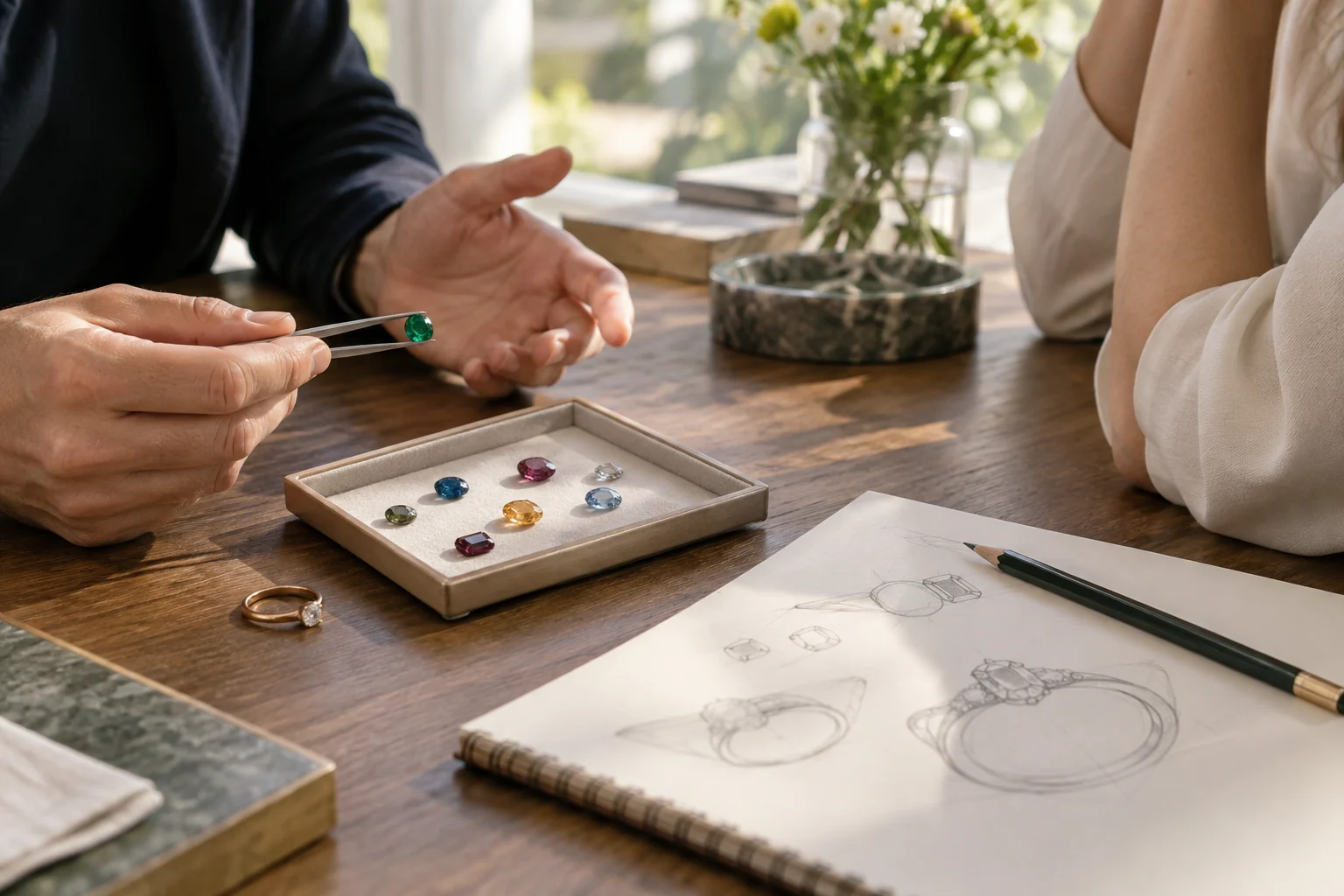
Ask the seller to describe the stone, any treatment it knows about and the origin information it can support. If the stone is laboratory-grown, recycled from an older piece or newly mined, ask for that distinction in writing rather than inferring it from its appearance.
A statement about the metal does not automatically answer questions about a stone. Nor does knowing a country of origin resolve every environmental or labour issue. Be specific about what you want to understand, and allow “unknown” to remain an honest answer where the seller cannot substantiate more.
For a high-value stone, discuss what independent identification or grading documentation is appropriate. Do not treat a decorative presentation certificate as equivalent to every kind of technical assessment. Ask who produced a document and what it actually establishes.
Know what a hallmark does
The British Hallmarking Council's guidance explains the role of independent precious-metal purity verification. Read a hallmark for that purpose. It does not establish a gemstone's origin or certify the whole supply chain's social performance.
This distinction helps organise the paperwork. Keep purity information, sourcing information and any stone documentation as separate records of different facts. Combining them in one folder is sensible; combining their meanings into one general guarantee is not.
If buying online, ask for clear images and an accurate description of the marks where relevant. If you cannot interpret them, seek an explanation from the seller or an appropriate assay-office resource rather than guessing from a tiny photograph.
Ask about the maker and future care
Find out who will carry out any commissioned work and how changes are agreed. You may be dealing with a designer, a workshop, a retailer or a combination. Understanding that relationship makes it easier to know who should answer a materials question or handle a later repair.
Discuss resizing, cleaning, inspection and replacing worn components before purchase. Ask what the jeweller recommends for the specific design, not a generic treatment for every metal and stone. Some settings, finishes or materials need particular care.
For a commission, agree what happens if the specified material becomes unavailable. Ask whether an alternative requires your approval and whether the documentation will change. A clear process is more useful than an unsupported promise that every future choice will be identical.
Keep the decision record short
A useful record can fit on one page: item description, metal and stone details, exact sourcing claims, supporting references, price, agreed changes and aftercare arrangements. Save the quotation and final invoice with it.
Read the final description before collecting or accepting delivery. If it differs from the quotation, ask for the change to be explained. For gifts, pass on the care instructions while retaining the purchasing documents in a place that can be found later.
Good sourcing information does not need to overwhelm the personal meaning of jewellery. It should make the practical decision clearer, allowing the piece to be valued for its design and significance without asking you to rely on claims that nobody has explained.

Questions about this article or a correction to suggest? Get in touch. Read more about our editorial approach.