If you are asking what RWS wool is, the short answer is this: it is wool from farms certified to the Responsible Wool Standard, with that wool then tracked through certified stages of the supply chain. An RWS claim is not just about the sheep farm. It also depends on chain of custody rules being followed as the fibre moves through scouring, spinning, knitting, weaving, dyeing and garment manufacture.
That makes RWS useful, but narrower than many clothing labels imply. It tells us something specific about animal welfare and land management requirements on certified farms, and about traceability through certified sites. It does not, by itself, prove that a jumper is low impact, fully ethical, long lasting or free from problematic processing.
What RWS wool actually means
Responsible Wool Standard is a voluntary certification standard for wool. It was developed to set requirements for sheep welfare and for land management on farms, and to connect those farms to a traceable supply chain. The standard is owned by Textile Exchange, a non-profit organisation whose standards and benchmarking work are widely used in fashion and textiles.
In practice, when a garment is sold with an RWS claim, the claim should mean two things.
First, the wool came from farms audited against the Responsible Wool Standard farm requirements.
Second, the wool was handled through a certified chain of custody, so the fibre sold as RWS is documented as such through each relevant stage.
That sounds straightforward, but it is worth being precise about what a reader can infer. RWS is not a vague “better wool” badge. It is a defined standard with a set scope. If a knit is labelled as containing RWS wool, we can infer that the wool should come from certified farms and should have remained under certified control through the supply chain. We cannot infer that every part of the product is certified, unless the claim clearly says so and the fibre content supports it.
We also cannot infer that the whole business behind the garment is ethical in every respect. A brand may sell one certified wool style while using conventional fibres elsewhere. Equally, an RWS claim on wool says nothing on its own about buttons, trims, packaging, transport or retail operations.
For UK readers, the legal point sits alongside the certification point. In the UK, product claims must not mislead under consumer protection rules. So if a label or product page uses RWS wording in a way that suggests more than the standard actually covers, that matters. Certification does not give a brand permission to overstate the case.
What the standard checks on farms
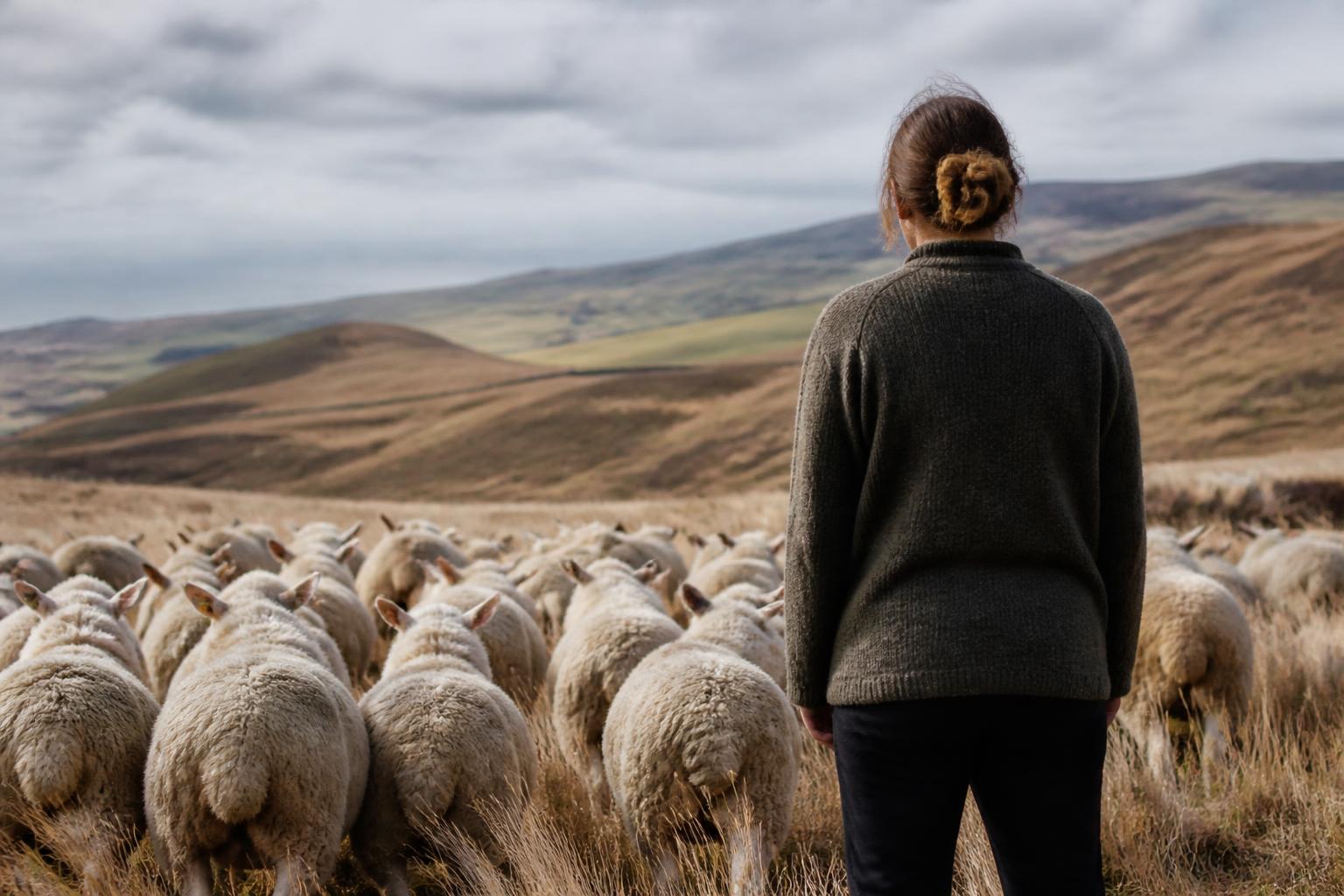
At farm level, RWS focuses on sheep welfare and land management. Those are the two pillars most people have in mind when they ask what Responsible Wool Standard wool means.
On animal welfare, the standard addresses the treatment of sheep across key stages of life. It looks at the Five Freedoms framework as a basis for welfare expectations, including freedom from hunger and thirst, discomfort, pain and distress, and the ability to express normal behaviour within the farming system. In practical terms, audits look at husbandry, handling, shearing, transport related practices on farm, and euthanasia where relevant.
One point many shoppers care about is mulesing. Responsible Wool Standard prohibits mulesing. That is one reason RWS often appears in discussions about merino sourcing, especially where buyers want reassurance on this issue. If you want the wider ethical context around breed, husbandry and sourcing questions, our guide on whether merino wool is ethical for UK clothes buyers goes into that in more detail.
On land management, the standard requires farms to work in ways intended to protect soil health, biodiversity and native species, and to plan grazing so land condition is monitored and managed. The emphasis is on responsible management rather than on proving a particular climate or biodiversity outcome. Farms are expected to have systems, records and practices in place. Auditors then assess whether those requirements are being met.
That distinction matters. Certification standards often check compliance with processes and criteria, not guaranteed environmental results. A farm can meet the standard and still operate within the real limits of weather, landscape and commercial agriculture. RWS is best understood as a framework for better practice and accountability, not a promise that every certified farm is ecologically exemplary in every respect.
Audits are carried out by approved third-party certification bodies, not by the brand buying the wool. Farms need to be inspected and certified, and there are surveillance and recertification processes rather than a one-off sign-off. Audits typically include document review, site inspection and interviews. Group certification may also be used in some contexts, which can make certification more accessible for smaller producers while relying on internal management systems and external verification.
Still, certification has limits. An audit is a structured check at a point in time, supported by records and procedures. It is not continuous observation. It reduces uncertainty, but it does not remove it. Nor does it cover every possible welfare or ecological concern a reader may have. If you want proof of regenerative outcomes, catchment-level biodiversity recovery or farm-level carbon data, RWS is not designed to supply that by itself.
How RWS follows wool through the supply chain
A wool claim only works if the fibre remains identifiable after it leaves the farm. That is where chain of custody comes in.
Under RWS, supply chain sites that take legal ownership of the certified wool and want to make certified claims usually need certification to the relevant chain of custody requirements. In textile certification, this commonly means alignment with the Content Claim Standard framework used by Textile Exchange. The purpose is to make sure that certified input and certified output can be reconciled through records, stock control and transaction documents.
For wool, that matters because supply chains are often long and fragmented. Greasy wool may be sold to a merchant, scoured in one country, spun in another, knitted elsewhere, dyed at another mill and finally cut and sewn into garments. If one of those stages falls outside the certified chain where certification is required for the claim being made, the final RWS claim may no longer be valid.
Transaction certificates are a key document here. A transaction certificate is issued by a certification body for a sale of certified goods between certified companies. It records what was sold, in what quantity, and under what certified status. Brands and suppliers use these certificates to support the claim that the wool in the finished product really is certified material.
For a small fashion business, this is often the point where things become more complicated than expected. Buying yarn from a spinner that says it uses RWS wool is not enough if the paperwork does not support the claim through to your business. If you are placing your own label on products and want to describe them as RWS, you normally need to check not only the farm source but also the certification status of each relevant supplier and the availability of transaction certificates.
The wording on a product can also depend on whether the wool is fully certified content or part of a blend. That is similar in principle to other fibre claims. Our piece on what BCI cotton means when you read a clothing label is useful if you want a comparison with another chain-of-custody based sourcing claim.
One more practical point for UK businesses, especially those importing finished goods. Customs paperwork and commercial invoices are not substitutes for certification documents. They may help establish origin or shipment details, but they do not replace the transaction certificate and certification records needed to support an RWS content claim.
What RWS does not cover
This is where many misunderstandings begin. RWS covers important things, but not everything people care about when buying wool.
It does not certify climate impact. A garment made with RWS wool is not automatically low carbon. Sheep farming involves emissions, and the standard does not turn wool into a climate-neutral fibre.
It does not guarantee broad biodiversity outcomes beyond the standard’s own land management requirements. A certified farm should meet those requirements, but that is different from proving measurable species recovery or landscape restoration.
It does not certify chemical processing across the whole life of the product. Scouring, dyeing, finishing and other wet processing steps may involve chemicals and environmental controls that RWS itself does not fully govern. If you want assurance on restricted substances, wastewater controls or safer chemistry, you may need other standards or disclosures alongside RWS.
It does not cover all worker rights in the way some readers assume. Farm welfare and land management are central, and chain of custody certification checks traceability and handling of certified material. That is not the same as a full social certification for every worker in every mill and factory involved. Some sites may hold additional social or environmental certifications, but RWS alone does not prove that.
It does not guarantee product quality or durability. A cardigan made with certified wool can still pill, stretch, felt or wear out quickly if the yarn quality, knit structure or finishing are poor. Certification tells us about sourcing conditions and traceability, not whether the garment is well made.
It also does not tell us everything about fibre origin in the way some shoppers would like. You may know the wool is certified, but not necessarily the exact farm name, region or flock unless the brand chooses to disclose that level of detail.
For readers comparing material claims more broadly, this is a familiar pattern. Certifications and fibre labels are often specific tools rather than all-purpose verdicts. We see the same issue when brands simplify complex materials into neat marketing lines, whether they are talking about wool or what recycled nylon fabric is and what claims it can support.
How to read RWS claims on labels and product pages
The most useful habit is to read the exact wording.
“Made with RWS wool” usually means the product contains some amount of Responsible Wool Standard certified wool, but it does not tell you the percentage unless the fibre composition is listed separately. In UK clothing, fibre composition should already be declared under textile labelling rules, so you should be able to see whether the garment is 100% wool or a blend such as 80% wool and 20% polyamide.
“100% RWS wool” should mean that all the wool content in the product is Responsible Wool Standard certified. It does not mean the whole product is 100% certified in every component. Threads, elastane in cuffs, linings, trims or non-wool details may sit outside that claim unless the brand states otherwise.
“Contains RWS certified wool” is similar. It can be a valid and accurate phrase, but it is broader and less precise than many readers realise. It confirms presence, not totality.
With blends, wording matters even more. “Made with 60% RWS wool and 40% recycled nylon” is clear. “Made with responsible wool and recycled fibres” is much less useful, because it leaves the reader to guess what proportion is certified and what certification, if any, applies to the other fibre.
For product pages, we look for three things.
First, is the fibre composition stated clearly?
Second, is the certification named properly as Responsible Wool Standard or RWS, rather than hidden behind vague wording such as “responsibly sourced wool”?
Third, is there any indication that the brand understands the scope of the claim, for example by distinguishing animal welfare and traceability from wider environmental performance?
For small brands, the safest route is plain language. Say what is certified, say what percentage of the fibre it covers, and avoid implying that RWS verifies matters outside its scope. If your wool is certified but your dyehouse is not covered by another environmental standard, do not write copy that suggests the entire product lifecycle has been independently approved.
When RWS is useful and when you need more evidence
RWS is useful when you want a credible sourcing signal on sheep welfare, mulesing prohibition and traceability of wool through certified supply chains. It is especially useful in categories where wool origin is otherwise opaque, or where a brand has historically offered little detail about animal fibres.
It is also useful for small fashion businesses that need a recognised framework rather than trying to build private welfare claims from scratch. A standard with third-party certification is generally more robust than a supplier’s informal assurance.
But there are plenty of situations where RWS is only a starting point.
If you want to understand environmental impact in more detail, ask where the wool was farmed, what kind of farming system produced it, what processing stages were used, and whether there is evidence beyond certification. For some buyers, regional origin matters because climate, water availability and land pressures differ significantly between wool-growing areas.
If you want assurance on chemical management, look for separate information about dyeing, finishing and restricted substances.
If you want confidence on labour conditions in manufacturing, ask about the cut-and-sew factory and relevant social standards or audit programmes.
If you care about longevity, inspect construction, yarn quality, fabric weight, repairability and care instructions. A well sourced fibre in a poorly made jumper is still a poor buy.
That is the practical answer to the question of what Responsible Wool Standard wool is. It is a meaningful certification, but a bounded one. We treat it as evidence of something real and specific, not as a shortcut to “good” in every sense. For readers and brands alike, that is the most useful way to trust the label without asking it to prove more than it can.

Questions about this article or a correction to suggest? Get in touch. Read more about our editorial approach.