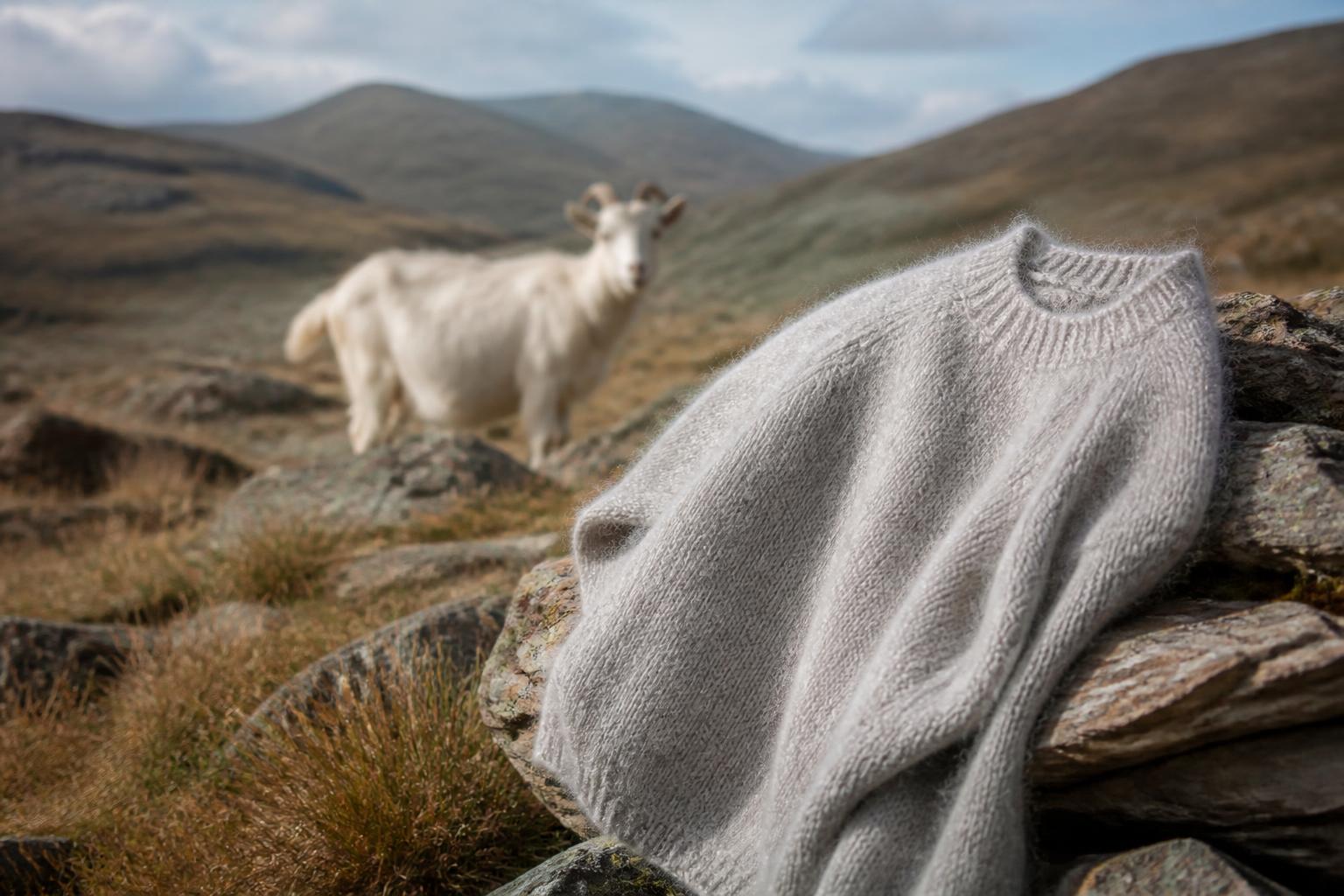
Mohair can be ethical, but it is not ethical by default. If you are asking whether mohair is ethical for UK fashion buyers, the honest answer is that it depends far more on animal welfare controls, farm practices, shearing methods and traceability than on the fibre name alone.
That matters because “mohair” on a label tells us what fibre was used, not how Angora goats were treated, how the fibre moved through the supply chain, or whether a brand has checked conditions beyond a first-tier supplier. For both shoppers and small fashion businesses, mohair is best treated as a sourcing question, not a simple material verdict.
What makes mohair an ethical question?
Mohair is the fibre shorn from Angora goats. It is valued for lustre, warmth, resilience and a smooth handle that can look more polished than many woollens. In knitwear and tailoring blends, it often appears in relatively small percentages, mixed with wool, polyamide, silk or acrylic to alter texture and performance.
The ethical question starts with the animal. Unlike plant or synthetic fibres, mohair production depends on live animals being bred, handled, transported and shorn repeatedly. That brings welfare issues into view immediately. A fibre label cannot tell us whether goats were shorn carefully, whether kids were protected from cold stress after clipping, whether injuries were treated properly, or whether handling on farm and during transport met a credible welfare standard.
Farming conditions matter too. Mohair is produced in several countries, with South Africa historically central to global supply. Conditions vary by climate, grazing system, labour practices, veterinary access and farm management. A soft jumper sold in the UK may have passed through multiple stages before retail, including scouring, spinning, dyeing, knitting or weaving, and garment manufacture in different countries. Without supply chain visibility, a brand may know the composition of a garment while knowing very little about the conditions behind the fibre.
This is why the question is not simply “animal fibre or not”. It is whether a buyer can see enough evidence about welfare, traceability and oversight to judge risk. We take the same approach when assessing other fibres and claims. If you want a useful comparison point, our guide to whether alpaca wool is an ethical choice for fashion buyers shows how similar questions arise across animal-based materials, even when the welfare profile differs.
How serious are the animal welfare concerns?
The concerns are serious enough that buyers should not treat mohair as low-risk without proof. Public scrutiny of the sector has focused on shearing and handling practices, especially rough restraint, cuts during clipping, distress of young animals and poor treatment of weaker or injured goats. Standards bodies and responsible sourcing schemes have also highlighted broader welfare needs, including feed and water, shelter, disease management, transport and slaughter conditions.
Shearing is one of the clearest pressure points. Angora goats need regular clipping, but necessary husbandry can still be done badly. The ethical difference lies in competence, restraint methods, timing, supervision and aftercare. For example, newly shorn animals can be vulnerable to weather exposure, and young kids can face particular risk if clipping is mistimed or if housing and protection are inadequate.
Practices vary substantially. That variation is important, because it cuts against two lazy conclusions. The first is that all mohair is unethical. The second is that any mohair product must be fine because shearing is routine. Neither is careful enough. Some farms may operate with strong welfare protocols, trained shearers and credible audit requirements. Others may fall short, especially where buyer oversight is weak, commercial pressure is high, or traceability stops early in the chain.
For UK buyers, that means we should look for evidence of active management rather than broad reassurance. A brand that says only “natural”, “luxury” or “responsibly sourced” has not answered the actual welfare question. We want to know whether there is a recognised standard, what part of the chain it covers, how claims are verified, and whether the brand can explain where the mohair came from and who monitored it.
Small brands should be especially careful here. If you are sourcing through agents, fabric mills or wholesalers, you may not have direct access to farms, but you still need documentation. A purchase order and a composition sheet are not enough. Ask for transaction certificates where relevant, supplier declarations, audit scope, and confirmation of whether the fibre remained segregated or mass balanced through processing. If a supplier cannot answer basic welfare and traceability questions, that is useful information in itself.
Which certifications and standards actually tell you something?
A recognised standard can tell you something useful about mohair, but only if you read the scope properly. The most relevant benchmark in this area is the Responsible Mohair Standard, usually referred to as RMS. It was developed to address animal welfare and land management at farm level, with chain of custody requirements intended to support traceability through the supply chain.
RMS is useful because it is specific to mohair and focused on the main ethical pressure points. It is designed to cover welfare principles for Angora goats, handling and shearing practices, and aspects of land stewardship. It also includes chain of custody requirements so certified fibre can be tracked through subsequent stages. For a UK buyer, that is a stronger signal than an unverified “ethical mohair” claim on a product page.
But RMS does not prove everything. It does not make a garment impact-free. It does not automatically tell you about every social issue in garment manufacture, chemical management in dyeing, or the full climate footprint of the finished product. It also does not remove the need to ask how much of the product is certified fibre if the item is a blend.
Other standards may appear alongside mohair products, but they answer different questions. Organic textile standards are less central here because mohair is not widely presented through the same route as some cotton supply chains, and an organic claim would still need careful checking for scope. A general textile certification may say something about chemical residues or processing conditions, but not necessarily about goat welfare. Recycled standards are only relevant where recycled mohair or recycled blended content is being claimed.
That distinction matters on labels and product pages. A chain of custody standard tells us certified material was tracked. An animal welfare standard tells us something about conditions at farm level. An environmental processing standard may cover restricted substances or wastewater controls. These are not interchangeable.
For UK businesses placing products on the market, this clarity is increasingly important because broad environmental and ethical claims face closer scrutiny. In Great Britain, the Competition and Markets Authority’s Green Claims Code sets expectations around evidence and clarity. In the EU, parallel pressure comes through consumer protection enforcement and newer rules tightening how environmental claims are presented. The legal routes are not identical, but the practical lesson is the same. If you imply more than your evidence supports, you create risk.
How should readers assess mohair claims on clothing labels?
Start with the fibre composition. If a jumper says 12 per cent mohair, 38 per cent wool, 47 per cent polyamide and 3 per cent elastane, that tells you mohair is present, but only as one component in a broader material system. It does not tell you whether the mohair was certified, whether any wool in the blend was certified, or whether the synthetic content was virgin or recycled.
Next, check for a specific sourcing claim. “Contains responsibly sourced mohair” is not the same as “made with Responsible Mohair Standard certified fibre”. The second is more concrete, though still worth checking for detail. If the brand names the standard, says whether the product is certified, and can provide certification information on request, that is more persuasive than generic ethical language.
Country references need careful reading too. “Made in Italy” may refer to garment assembly or knitting, not where the goats were farmed. “Origin: South Africa” may refer to the fibre, but not always the full chain. A label rarely carries enough room to explain every stage, so product pages and customer service responses often matter more than the sewn-in tag.
Recycled content claims also need precision. A brand may say a knit includes recycled mohair, recycled wool, or recycled polyamide. Each means something different, and a mixed statement can sound stronger than it is. If you want a practical framework for these mixed-material claims, our piece on how to judge designers using recycled materials sets out what to look for in percentages, certification and wording.
The same applies to vague sustainability language. “Conscious”, “eco”, “planet friendly” and similar terms do not establish welfare or traceability. They often sit beside a real attribute, such as recycled packaging or lower-impact dyeing, then blur into a much broader impression. We see this repeatedly across fashion categories, which is why our guide to greenwashing traps fashion shoppers should spot is useful reading before you rely on a short label claim.
For small fashion businesses, the assessment should go beyond the public label. Ask your supplier for the exact claim wording you are allowed to use, the supporting certificate, the percentage of certified fibre, and whether the claim applies to the whole product or only one component. Keep those records. In the UK, if you make the claim, you need to be able to substantiate it.
Is mohair better or worse than other animal fibres?
There is no universal ranking that settles this neatly. Mohair may be better on one issue and worse on another, depending on source, standard and farming context. Comparisons with wool, cashmere and alpaca are useful, but only if we keep the scope clear.
Compared with sheep’s wool, mohair is not automatically more or less ethical. Both involve shearing and ongoing husbandry, and both can be sourced under better or worse welfare conditions. Wool has its own welfare debates, including those linked to breed-specific practices in some regions. Mohair’s risk profile centres on Angora goat handling, clipping and farm management. The right question is not which species sounds gentler, but which supply chain offers stronger evidence.
Compared with cashmere, mohair sometimes benefits from clearer recognition of welfare oversight through a mohair-specific standard. Cashmere sourcing can be difficult to trace, especially in blended knitwear. But cashmere and mohair also differ in geography, grazing systems and market structure, so direct environmental comparisons are not straightforward. Claims about one fibre being categorically “more sustainable” than the other usually compress too many variables.
Compared with alpaca, mohair raises overlapping but not identical concerns. Alpacas and Angora goats are different animals, farmed in different regions and systems, with different common welfare issues. Evidence is also uneven across fibres. Some impacts are better documented than others, and not every life cycle assessment uses directly comparable assumptions. That is why we prefer decision frameworks over league tables.
There are, however, a few grounded observations we can make. First, any animal fibre with weak traceability is a higher-risk purchase than one with credible chain of custody. Second, a durable product that is well cared for may perform better in practice than a cheaper substitute replaced frequently, but durability does not excuse poor welfare. Third, blended garments complicate the picture because the ethical profile depends on all major fibres and on processing, not on mohair alone.
So, is mohair ethical in comparison with other animal fibres? Sometimes yes, sometimes no. It can be a lower-risk option than an opaque cashmere blend, and a higher-risk option than well-traced certified wool, or the reverse. The deciding factors are evidence and scope.
When is mohair a lower-risk choice?
Mohair becomes a lower-risk choice when three things line up. First, there is a credible animal welfare and traceability standard. Second, the brand or supplier can explain what that standard covers and provide documentation. Third, the finished product is presented with precise claims rather than halo language.
For shoppers, a practical decision framework looks like this:
Check whether the brand names a recognised mohair standard, ideally RMS.
Look for clarity on whether the actual product is certified, not just whether the brand uses certified mohair somewhere in its range.
Read the composition carefully, especially in blends. A certified mohair component does not certify the rest of the garment.
Check whether the brand gives meaningful sourcing information, such as fibre origin, supply chain stages or a clear responsible sourcing policy.
Be cautious with unsupported phrases like “ethical”, “sustainable” or “responsible luxury”.
Consider longevity and care. If the item is likely to pill badly, shed, felt or sit unworn because it is impractical, its ethical case weakens.
For small fashion businesses, we would tighten that into a buying checklist:
Request the current certificate and transaction documents linked to the fibre or yarn lot.
Confirm whether chain of custody is preserved through spinner, knitter or weaver, dyer and manufacturer.
Ask what the standard covers, farm welfare only, chain of custody, land management, or additional processing controls.
Check whether any public-facing claim needs exact wording under the certification scheme.
Map the non-mohair components in blends, because a responsible mohair claim does not solve issues in virgin synthetics, conventional wool or problematic trims.
Keep supplier disclosures on file, including declarations about country of origin and certified content.
In the UK, this matters not just for ethics but for claims compliance. If you sell online or in-store and present a product as responsibly sourced, you should be able to show what you relied on. If you sell into the EU as well, review those claims with extra care because expectations around substantiation and consumer-facing environmental messaging are tightening there too.
The most reliable sign that mohair is a lower-risk choice is not a poetic product description. It is a boring paper trail. When a supplier can show recognised certification, transaction-level traceability and clear claim boundaries, the material becomes easier to trust. When they cannot, the right answer is not to fill the gap with branding.
So, is mohair ethical? It can be. For UK buyers, the sensible position is neither to dismiss it outright nor to accept it on fibre name alone. Treat mohair as an evidence-based sourcing decision, and the quality of that evidence will usually tell you more than the softness of the knit.

Questions about this article or a correction to suggest? Get in touch. Read more about our editorial approach.