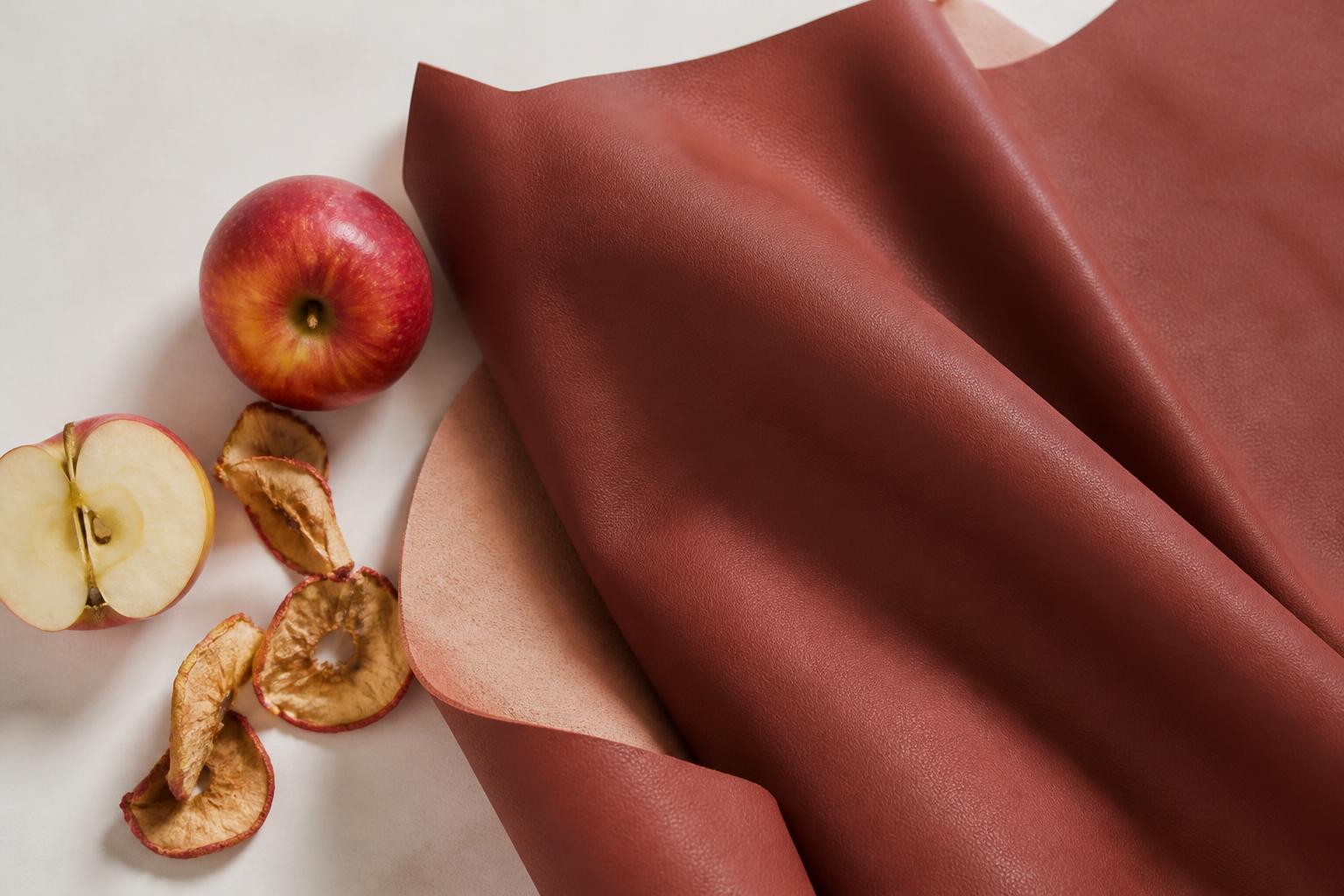
If you have been wondering what apple leather is, the short answer is that it is usually a coated sheet material made with some apple industry by-product, not a hide and not a purely plant-only fabric. In most cases, apple pomace or fibre from juice production is dried, ground and mixed into a plastic-based binder, then applied to a textile backing and finished to look and feel leather-like.
That matters because the name sounds more straightforward than the material usually is. “Apple leather” can suggest something made largely from apples, or something directly comparable to animal leather. In practice, it is normally a composite material. Its performance, plastic content, care needs and environmental profile depend heavily on the exact recipe, backing and coating system used.
What apple leather usually means in fashion
In fashion, apple leather usually means a vegan leather alternative that uses apple waste from the food industry as one ingredient in a coated material. The apple content may come from skins, pulp, stalks or pomace left after apples are pressed for juice or purée. Those leftovers are dried and processed into a powder or fibrous filler.
The important point is that this does not create a standalone sheet in the way an animal hide already exists as a continuous material. Instead, the apple-derived ingredient is typically combined with binders and coatings so it can be turned into something usable for bags, shoes, watch straps, trims and small accessories.
That is why the name can mislead. Apple leather is not leather in the legal or ordinary material sense used in the UK. Leather is animal skin or hide that has been tanned so it does not rot. If a product is made from a synthetic or composite substitute, calling it simply “leather” without qualification can create confusion. In retail, brands often use terms such as “apple leather”, “apple skin” or “apple-based vegan leather” to signal the look rather than the material category.
It is also not usually a fully plant-only material. Some buyers understandably assume that because apples are involved, the whole material must be natural, biodegradable or plastic-free. That is rarely the case. Most versions on the market rely on polyurethane, and sometimes polyester or other synthetics, for structure, flexibility, abrasion resistance and water resistance. If a product description does not explain this, it is worth being cautious.
This puts apple leather in the same broad family as many other alternative leathers made from agricultural by-products. The useful question is not whether the concept sounds innovative, but what the final material is actually made of, how much fossil-derived polymer it contains, and whether the maker is disclosing that clearly. Readers who have already untangled similar wording around composites may find our guide to what bonded leather means before you buy a helpful comparison point.
How apple leather is made
Most apple leather starts with by-product from food processing, often from apples used for juice, jam or purée. Instead of treating that residue as waste, the producer separates and dries it. Moisture has to be reduced significantly so the material can be milled and stored without spoiling.
Once dried, the apple matter is ground into a powder or processed into a fine fibrous ingredient. At this stage it is not yet a usable textile or sheet. It behaves more like a filler or feedstock.
The next steps vary by manufacturer, but a typical process looks like this:
First, the apple-derived powder is blended with a binder system. In current commercial materials, that binder is often polyurethane, water-based polyurethane, or another polymer formulation. The binder is what helps the particles adhere and form a continuous layer rather than a crumbly mass.
Second, that blend is spread or coated onto a backing. The backing might be polyester, recycled polyester, cotton, viscose, or a mixed textile. In some constructions, the backing provides most of the tear strength and dimensional stability. That is one reason two products both sold as apple leather can behave very differently in wear.
Third, the surface is dried and cured. Depending on the system, this may involve heat, pressure or multiple coating passes. Some materials have a separate top coat added afterwards to improve scratch resistance, stain resistance, colour fastness or water repellency.
Fourth, the sheet may be embossed to create a grain pattern. Many leather alternatives are finished this way, because the embossed surface helps deliver the familiar visual cues people associate with leather goods. Matte, pebbled, smooth and saffiano-style finishes are all possible.
Finally, the material is cut and made into products much like other coated fabrics. It can be stitched, edge-painted, backed with foam, laminated to reinforcements and assembled with the same hardware used in synthetic handbags or footwear uppers.
The detail that often gets lost in marketing is that the apple ingredient is only one part of a multilayer construction. A finished sheet may include an apple-filled coating, a polymer top layer, adhesives, a woven or nonwoven backing, dyes, pigments and surface finishes. If a supplier says only that it is “made from apples”, that tells us very little about the material we will actually be wearing or carrying.
How much of it is actually apple
This is where product claims become slippery. The proportion that is “actually apple” can differ widely depending on whether a brand is talking about the visible surface layer, the total coated compound, or the finished material including backing.
One supplier might quote a percentage for apple waste within the coating mix only. Another might quote total bio-based content for the whole sheet. Another might refer to renewable content rather than apple content specifically. These are not interchangeable claims.
For readers and small brands, the best starting point is to ask for a full composition disclosure in plain language. We want to know:
- what the backing is made from
- what the coating or binder is made from
- whether the apple content is measured by weight of the total product or only one layer
- whether any of the polymer content is recycled or bio-based
- whether the top finish differs from the main coating
Without that, percentage claims are hard to interpret. “Made with apple waste” could mean a meaningful share of the material, or a relatively modest filler content in a largely synthetic construction.
It is also worth asking how the claim has been verified. Bio-based content can be tested using recognised methods that estimate the share of carbon from recent biological sources rather than fossil sources. One commonly cited route is radiocarbon testing, often linked to standards such as ASTM D6866. That can be useful, but it does not tell us everything. It does not prove the material is biodegradable, plastic-free, low impact overall or free from problematic coatings.
If a supplier mentions “USDA Certified Biobased Product”, check what exactly was certified and at what percentage. If they mention a general bio-based figure, ask whether it covers the whole sheet or only one component. In the UK market, we also see brands repeating supplier percentages without clarifying the basis. That is not always intentional, but it can leave buyers with the wrong impression.
For small businesses sourcing materials, this is a good example of why headline claims need unpacking before they reach swing tags and product pages. We look at that wider problem in our guide to how the fashion materials market really works in the UK.
How apple leather compares with leather and synthetic alternatives
Apple leather sits somewhere between conventional synthetic leather and newer bio-based composites. It is not directly equivalent to animal leather, and it is not identical to a standard PU coated fabric either.
Compared with animal leather, its scope is narrower. Leather can be split, shaved, skived, burnished, reconditioned and, in some cases, repaired in ways many coated alternatives cannot. Good leather also develops a wear pattern that some people value aesthetically. Apple leather, by contrast, is generally a surface-engineered material. Once the coating is deeply scratched, cracked or peeled, repair options are more limited and often more visible.
Compared with standard synthetic alternatives, apple leather may reduce reliance on virgin fossil feedstock by replacing part of the formulation with agricultural by-product. That can be a genuine point in its favour, especially if the by-product would otherwise have little value. But that does not remove the plastic component. In many cases, the performance people want from the material, especially flexibility, rub resistance and moisture resistance, still depends on polymer layers.
Durability expectations should stay realistic. A well-made apple leather accessory can perform perfectly well in normal use, particularly in lower-stress applications. But the exact lifespan depends on thickness, backing, finish, construction details and care. A soft fashion tote, a structured card holder and a shoe upper do not place the same demands on a material.
Environmental trade-offs are also more complex than “plant good, animal bad” or the reverse. Animal leather raises questions around livestock impacts, tanning chemistry and whether leather should truly be treated as a by-product, an issue we unpack in our article on whether leather is really just a by-product. Apple leather avoids animal hide, and may use food industry residue creatively, but it often still depends on plastics, coatings and laminated constructions that complicate end of life.
So the practical comparison is not about finding a perfect material. It is about understanding which compromises you are making. Apple leather may offer a lower animal input route with some bio-based content and a leather-like look. It may not offer the same repairability, ageing pattern or long-term resilience as a high quality leather, and it is not usually free from synthetic content.
Which claims and certifications are worth checking
The most useful evidence is usually not the most glamorous badge. For apple leather, we would prioritise clear technical disclosure over broad sustainability language.
Start with composition. Ask for the fibre content of the backing and the chemistry of the coating. If the supplier cannot or will not state whether the top layer is polyurethane, that is a red flag.
Then look at restricted substances. For products sold in the UK, compliance with UK REACH matters. In the EU, REACH applies instead. The two systems are related but not identical, and businesses selling into both markets need to check both sets of obligations rather than assuming one automatically covers the other. Restricted substance testing can help support claims around heavy metals, certain solvents, phthalates or other chemicals of concern, but the exact relevance depends on the formulation.
If recycled or bio-based content is claimed, ask what standard or test method supports it. Good evidence might include third party certification for recycled content, or radiocarbon-based testing for bio-based content. Again, what matters is what part of the material was tested.
For coatings and textile components, some labels can be useful but limited. OEKO-TEX certifications, where genuinely applicable to the material in question, may indicate testing for certain harmful substances in the finished article or component. That does not prove low carbon impact, biodegradability or high bio-based content. Likewise, a vegan label tells us the material is not animal-derived, not that it is plastic-free or environmentally preferable overall.
If a brand highlights recycled polyester backing, that can be relevant, but it does not tell us much about the coating. If it highlights apple waste content, that does not tell us whether solvents, finishes or adhesives raise separate concerns.
We would also treat words such as “eco”, “sustainable”, “natural” and “planet-friendly” as prompts for follow-up questions, not evidence in themselves. The UK’s consumer protection approach to environmental claims has moved towards expecting businesses to hold clear substantiation. The Competition and Markets Authority’s Green Claims Code is part of that picture. It does not certify materials, but it does set a useful standard for how specific and supportable claims should be.
When apple leather may or may not suit a product
Apple leather can work well where the product needs a leather-like appearance without the use of animal hide, and where the construction does not place extreme stress on the material.
For small accessories, it often makes sense. Card holders, passport covers, cosmetic bags, watch straps and jewellery pouches are all applications where a coated material can look refined and perform adequately, provided the finish is decent and the edges are well handled.
In handbags, suitability depends on structure and use. A lightly used evening bag or a crossbody with moderate abrasion exposure may be a better fit than an unstructured everyday tote that is overloaded, dragged against rough surfaces and expected to age beautifully for years. Reinforcement panels, linings and edge paint quality matter just as much as the headline material.
In footwear, the demands increase. Uppers need flex resistance, surface durability and tolerance for repeated creasing. A supplier may have an apple leather specifically engineered for shoes, but that does not mean every apple-based material is suitable for every footwear style. Court shoes, trainers and sandals all stress materials differently, and failure often appears first at flex points.
For trims, panels and decorative details, apple leather may be entirely reasonable. It can offer a polished finish in places where the material is not carrying the full mechanical load of the product.
There are also care constraints to keep in mind. Most apple leather products should be treated more like coated fashion materials than like traditional leather. That usually means wiping clean with a soft damp cloth, avoiding saturation, keeping away from high heat and storing carefully to reduce creasing or sticking. Conditioning products made for animal leather are not automatically appropriate.
For brands developing products, the key question is whether the material choice matches the use case honestly. If a product is likely to be judged by ruggedness, patina and repairability, apple leather may not be the strongest fit. If the priority is an animal-free material with some bio-based content and a smart finish for a lower-stress application, it may be a sensible option.
So, what is apple leather in practical terms? Usually, it is a composite coated material that includes apple industry by-product, backed and finished with other ingredients that do much of the structural work. That does not make it meaningless, and it does not make it automatically virtuous either. It simply means the right way to assess it is the same way we assess any fashion material claim, by looking past the romance of the name and into the recipe, the evidence and the intended use.

Questions about this article or a correction to suggest? Get in touch. Read more about our editorial approach.